Showing posts with label writing. Show all posts

17 September 2014

Punch

I have this highly scientific, intellectual term for things that move me: they've got punch. No, not the magenta-coloured fruit drink that comes in cans of frozen concentrate. Or the equivalent, somewhat higher-class version mixed with rum that Mary Poppins takes from her medicine spoon (roll those rrrr's: "Rrrrum Punch!"), although the latter probably would have the kind of punch I'm talking about. I mean the kind of punch that socks you in the solar plexus, knocks out your breath for just a moment. In a good way, of course.

I don't know if anyone else uses that term, so I'm not sure if when I say something has punch, people actually understand me. The thing is that I haven't found any better term for that quality. I first came up with it when I was looking at art - actually, it might well have been my own. I've pulled off a few pieces that I liked, and when I tried to describe to myself why, I realised it was because they had that quality, had punch. Not too many, mind you - but a few. It's one of the most satisfying things when I create a piece with punch. I haven't painted or sculpted much lately (funny how grad school takes over your life and sucks out all your creative juices), but I'm sure if I spent a lot of time working on my art, the number of punch-y pieces would eventually increase quite a bit. See, that's what sets apart "real" artists from the dilettantes - real artists have work with punch. And the better they get, the more regular the punch.

Punch is not just found in visual arts, but also in something like this piece of writing by my friend Christopher Bunn, where he talks about joy in spite of difficulties. It's in poems that just knock you flat, because they say it so very precisely - whatever "it" is. It's in a musical composition that moves you to tears even if you don't know why.

So, if you ever show me a piece of art or writing or music you did, and I tell you it's got punch, know that you've been given one of the highest compliments I can bestow. Something with punch is more than just beautiful or skillfully executed, it's got content that moves me. Thankfully, it's not a very rare quality, I've seen it many times. It's not cheap; it does take skill, but more than that, it takes investment on the part of the artist or writer. In fact, perhaps it is that which comes through, the person of the creator, which reaches out and touches something in me.

Punch is hard to explain, which is also why I have yet to find a better, more sophisticated word to replace it. It's a quality I know when I see it, but I cannot tell you (or even myself) ahead of time how to achieve it. At least not yet. Maybe consistent punch comes with experience.

Life, the Universe, and Pieces with Punch. I know it when I see it.

Van Gogh: punchiest painter ever

24 July 2013

How to Write a Term Paper

Steve demonstrating the state of one's mind during Term Paper Writing
1.) Pick a topic. Find something you're interested enough in that you won't end up hating it after having completely immersed yourself in it for weeks on end.
2.) Vaguely think about it off and on while you do the other assignments for your course, hang around on Facebook, and read murder mysteries in your off time.
3.) Hit the library. No, wait - first hit the library's website, and surf around, following improbable rabbit trails through the jungle of Library of Congress Subject Headings.
4.) Repeat step 3.) on Google. It's amazing the stuff you can find - say you're researching Austen film adaptations, you might find out that Jennifer Ehle played some other costume drama with Jeremy Northam, and that she looked a whole lot better with her hair natural, rather than that dorky wig they put on her for the 1995 P&P. This step can occupy you for a long, long time.
5.) Go to the library and pick up the two dozen books you ordered in on your topic. Stack them around your computer.
6.) Panic.
7.) Send an email to your prof, whining about not getting ahead. Try to change your topic a time or two.
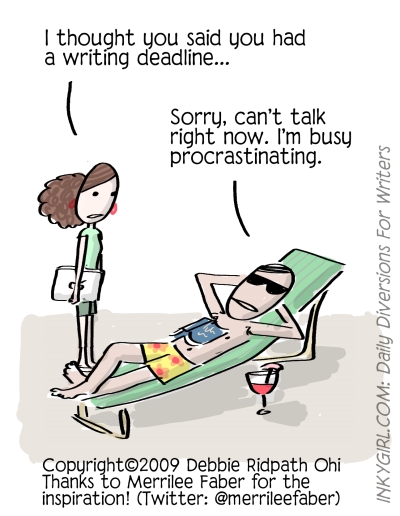
8.) Procrastinate.
9.) Panic.
10.) Get several pads of sticky notes, the real skinny strips, preferably fluorescent-coloured. You need them to mark sections you're going to quote in the books. Don't even THINK about actually highlighting library books, or even just underlining stuff and making notes in pencil. You will be smote by the library gods. (I'm sure there are some. Some Greek gods of libraries? And they're very smiting, believe me. Especially after having had their powers enhanced by my righteous indignation at all those scribbles and markings in the margins. Grrrrrr...)
11.) Repeat step 4.)
12.) Go on the library website, pull up the databases the library subscribes to, and repeat step 3.) Save about three dozen references in a special folder. The next day, go back and open every single one of those .pdf files which will all have titles like 678459q84.pdf, and rename them so you can actually recognize them when they're closed. Go back into the databases, repeat your search, then actually save the references to the files you've found. Export them to RefWorks.
13.) Panic.
14.) Eat copious quantities of snacks.
15.) Start reading. Or at least, open those .pdf files, and skim over the contents. Highlight interesting sentences, even if you have no clue what the author said on the page before or after the quote. (Yes, you may highlight. The library gods do not care about alterations of electronic files.)
16.) Crack open the covers of those library books, and follow the general principle of step 15.), replacing "highlight" with "sticky-note". You may write on the sticky note, if you manage to not draw outside the line and accidentally write on the page of the book. If you do the latter, you will be smote.
17.) Procrastinate.
18.) Panic.
19.) Feel put upon.
20.) Pace.
21.) Open several text files in your favourite writing program, such as Scrivener. One will be your main text body. Another will be random notes. Scribble down everything and anything that came into your head when you were doing all that pacing, procrastinating and panicking (see, they have a purpose!). Copy and paste quotes you want to use from the .pdf's; swear at the fact that Adobe Reader won't let you copy something you've highlighted. Go back and pull a clean .pdf off the net, so you can copy and paste from it. Manually copy quotes from the hardcopy books. Throw all those citations randomly into your notes file.
22.) Sleep and eat. Don't panic too much at this point, it interferes with sleeping and eating.
23.) Whine at your family and friends about the stress levels you're under. Tell them what you're writing about (it helps. See "pacing, procrastinating and panicking"). Stop telling them when their eyes glaze over.
23.) Open your notes file. Sort your ideas into a semblance of sense. Cut and paste the quotations, and stick them in the right categories.
24.) Panic.
25.) Open your text body file in one window, your notes file in another. Take a deep breath. Start typing.
26.) Keep telling yourself "Just write, just write, just write - you can edit it later - just write... yes, this sounds awful... just write..."
27.) Make sure to frequently hit "save".
28.) Repeats steps 22.), 23.), 24.) - 27.) as often as needed.
29.) Include in-text citations as  you write, or leave them to the end, as you choose.
30.) Read over what you've done. Fix the really glaring nonsense (if the wording makes you gag, chances are your prof won't like it either).
31.) Boot up RefWorks, pick the four references you actually used of the three dozen you saved, and build your Works Cited list. Manually enter the reference information for the hardcopy books.
32.) Copy and paste it to your text file.
33.) Pick a snappy title for your piece.
34.) Export everything to the file that will be your final paper file.
35.) Spellcheck and format your paper. Swear at the word processing software which does weird things with margins and fonts, and insists on spellchecking in US English instead of British or Canadian. No, I do NOT want to change "colour" to "color"!
36.) Hit save.
37.) Have a glass of wine or two to celebrate. Go sleep.
38.) Open the file, read it over. Shake your head at all the mistakes you've missed. Fix them. Make sure all your citation information is correct and shipshape.
39.) Save everything to a few other files, just to make sure you don't lose it. Give the files an academic-sounding name. (No, "Bob" won't do.)
40.) Read the paper over again, just to be sure.
41.) Address an email to your prof; attach the file. Quadruple-check that you've actually attached the file and aren't sending him a blank mail. Hover your mouse pointer over the "send" button. Take a deep breath, then another for good measure. Panic mildly. Click "send".
42.) Abandon yourself to The Euphoria of Completion.

There you have it - Forty-Two Steps to Writing a Term Paper. Well, they work for me, anyway. You're welcome.

30 April 2013

The Euphoria of Completion

SQUEEEEEAK! That was the sound of me squeaking in just under the wire with my term paper. Okay, technically I could have had until the end of June to finish this course, but I wanted to get it done before the summer semester starts tomorrow. So I buckled down, and got 'er done, just. And oh, does it ever feel good!

Have you ever felt that, the euphoria of completion? Post-term-paper euphoria. Post-exam euphoria. Graduation. Reaching the mountain summit. Crossing the finish line on a marathon. Okay, okay, I've never experienced the last one, being an inveterate couch potato. And the one before that only under duress - when I was a kid, they made me go hiking in the Swiss Alps in our holidays, when I would have much preferred to stay home with a book. I was so put-upon, I was. Once I got a bit older, I did go hiking voluntarily, especially when there were friends involved. But really, I usually preferred the easier hikes, not the ones that were really strenuous. The mountain tops were still quite nice there, but I'm pretty sure that the thrill of the summit is directly proportionate to the strain of the climb.

That's why it feels so great to have these term papers out of the way. You see, I do get in quite a flap about writing those things. My stress level rises to the roof, my blood pressure tries to follow suit, and my acid reflux... well, you get the picture. So why do I do these things in the first place? Why did I get myself into this degree program? It would have been so much easier to rest on my laurels (or my BA certificate, as it were. Except it wouldn't be very comfortable, and probably get crumpled, which would be a pity.). Well, why do you climb the mountain, or run that marathon? Because you know you have to, that's why.

And so you lace up your hiking boots, boot up your computer, lay out your paintbrushes and strap that four-foot canvas to the easel. You go to the library and check out foot-high stacks of books on Goethe and Kate Chopin, get the 1:50,000 topographic map that shows all the little hiking trails, do your training runs along the back roads of your town. And then you just get down to it. You run the race, climb the climb, paint the picture, write the paper. On and on, and on some more.

And then it's done. You crest the summit. And put your signature in the bottom right corner. And cross the finish line, type the last sentence, format the references, finally click "submit".

And you abandon yourself to the head rush of completion. Yesss!! You take a few deep breaths of the mountain air, and just take in the view. Look, there's the path we came up on! Oh, see, that's the spot where the cat wiped her tail through the ultramarine blue. Hey, that reference came from the article on Goethe and Chopin, that was fascinating. And aren't you glad somebody had a bottle of water for you at the half-way point? Now that you're done, you can look back, and turn the experience into story. You can start telling others how you got here. But first, you have to get here, you have to finish.  And when you do, it's all been worth it.

Life, the Universe, and The Euphoria of Completion. There is no other feeling like it.

07 April 2013

Whom

Random picture of cat hanging out on towel shelf
I was reading this most excellent little book the other day: Steal Like an Artist, by Austin Kleon. Great book, really. And then suddenly I run across this passage: "First, you have to figure out who to copy. Second, you have to figure out what to copy. Who to copy is easy. You copy your heroes - the people you love, the people you're inspired by, the people you want to be. ... What to copy is a little bit trickier. Don't just steal the style, steal the thinking behind the style. You don't want to look like your heroes, you want to see like your heroes" (p.35/36). It's another articulation of Kleon's main point: There is nothing new under the sun. Everything we do has been informed by the work that's gone before us, so we might as well acknowledge it and capitalise on it. Oh, and if you're wondering what the difference is between good  theft and bad theft (of ideas, that is): good theft credits, bad theft plagiarises (i.e. claims the idea for one's own). So I've just committed good theft here, because I'm crediting Kleon's great book. Go out and buy a copy, it's worth it.

However, that's really not what I was going to waffle on about. What got me to writing this is the little matter of a missing "m" in the first sentence. Did you spot it? "...you have to figure out who to copy." And then again: "Who to copy is easy..." Urgh. The grammar nerd in me is drumming its heels on the floor right now. Whom, people, whom! But then, I had to tell my grammar nerd, just shut up. Because the fact of the matter is that normal people, people like you and me, don't actually say "whom" in daily life. Well, okay, maybe you do - I don't. "Figure out who to copy" is exactly what I would say if we were talking about rip-off artistry in real language, the spoken tongue-and-lips variety, right now. And Kleon's book is written just as if he was talking real-life talk; he writes colloquial. So, I vote, he can get away with it.

Because, you see, language changes. Yes, "whom" is the correct form. And I'm going to keep using it where it's appropriate in my writing, because I'm kind of anal that way. But to turn up one's nose at those who cannot or will not use the accusative of the interrogative pronoun where it is called for is a sign of mental immaturity. Or, in normal language, don't be a snooty so-and-so about using "whom", it's childish. As I said, language changes - we no longer say "whence" for "from where" either, and I bet it first started with spoken language.

However, if you do have, somewhere in the depths of your being, a long-held desire to plumb the mysteries of said interrogative pronoun - in other words, if you want to know when to say "who" and when to use "whom" - let me give you a little hint. The form "whom" is called the accusative because it's the word we use when we accuse someone. Whom do we accuse of being a snooty so-and-so? Him, that's whom. Who does the accusing? He, that's who. See? It's pretty easy. When the answer is "him", you use "whom", when it's "he", use "who". That's why, strictly speaking, in Kleon's sentence it should be "whom", because when you copy Van Gogh (or Austin Kleon), you copy him, not he.

And then there's this writer I met who told the story of how he was standing in line at the deli counter in the grocery store. The sales lady turned to him and the people next to him, and asked: "What can I get for you?" The writer, being of the well-spoken variety and not entirely clear on who was next in line, asked: "To whom are you speaking?" Without missing a beat, she replied: "To youm!"

Life, the Universe, and Interrogative Pronouns in the Accusative. Whom are you going to read next? I recommend Austin Kleon.

11 September 2012

Quill and Qwerty

The quill and the QWERTY. Well, the quill and qwerty keyboard, anyway. It's amazing what's come out of those humble tools in the last, oh, four millenia. (I do believe the ancient Egyptians already used the quill to draw their strange cubist pharaohs, so, yes, four millennia. If not more.)

I did a bit of writing with a dip pen the other day (I'll tell you about that some other time), and found myself quite astonished that the likes of Austen were able to write whole books with that method. And they had really fancy handwriting, to boot. Once, a long time ago, I tried using a proper quill, i.e. a goose feather carved to shape with a sharp knife, and I couldn't manage it. Scrape, scratch, splatter...

And now I'm so used to the computer QWERTY keyboard that I'm starting to find myself amazed how anyone could write whole books by hand at all, even with a regular pen, be it ballpoint, fountain, gel or felt. Or a pencil.

For me, ballpoint would be out of the question; I get hand cramps from those things in very short order. Gel isn't much better. Felt is okay, but my writing instrument of choice for anything meant to be permanent is a fountain pen. Yes, an old-fashioned fountain pen. Though not quite as old-fashioned as the one in the picture; that one belonged to my grandfather, so it's from no later than the 1950's, maybe even as old as the 1920's or 30's. It's the plunger type, with a piston ink reservoir in the belly.

No, the kind I use are the ones I learned to write with, back in Germany in the 70's, with neat and tidy ink cartridges to put in it. Usually royal blue, but when I got to my teens I really enjoyed paying a bit extra and getting the fancy coloured inks. They even had scented ones for a while in the little junk shop where I liked browsing. My grade 11 math teacher was not impressed with the yellow and orange; he said he could barely see them on the page. So I had to switch back to turquoise, and green, and purple. I even had brown for a while; but I can't remember what the scent of that one was. (No, it definitely wasn't what you think! Get your mind out of the gutter.)

Now, I just rattle my fingers over the keyboard, with great speed and inaccuracy. My backspace button gets used about as much as the space bar, I think.

Life, the Universe, the Quill and QWERTY. What's your favourite writing tool?

07 August 2012

Who Do You Think You Are?

I was talking with my friend the other day. About life, the universe, and making things, about ourselves and the difficulty of putting ourselves out there for others to see. We talked about how there are these ideas we have and we would like to express, but how there's so often something holding us back. And how the most potent of those somethings is that one insidious question: "Who do you think you are?"

After I got home, I kept thinking about it all. "Who do you think you are?" And it crossed my mind: what would happen if, just for once, I answered that question?

So, let's try it. Who do you think you are? Well, I think I'm a 5'9" German, with blue eyes and greying brown hair. I think I'm a mother. I think I'm a grad student. I think I'm a writer. BAM!! I just ran into an invisible wall.

Not unlike the visitor we picked up from the airport, who, after collecting his suitcase from the luggage carousel, in his jet-lagged state walked right into the glass wall that forms the little foyer around the exit doors. I'm afraid I laughed - it did look just a bit too cartoonish how he bounced off that sheet of glass, and he wasn't, after all, really harmed. Just a little stunned. And all he had to do was take two steps to the left, three forward, turn right, and - Open Sesame!- the sliding doors parted, and parted again, to let him emerge into the spring sunshine. All of which, I'm happy to report, was accomplished without any further mishaps or injury to health or dignity; and we had a lovely visit for the remainder of his stay at our house.

However, not all invisible walls are as easily dealt with as the sheet of glass at the airport. Or are they?

Steve and a Glass Wall
You see, brick walls, even the ones that have been tidily plastered over and painted a delicate shade of rose pink, they're easy to identify and avoid. "Who do you think you are?" Well, I don't think I'm an Olympic gymnast, because I've known I'm athletically challenged since at least the first day of gym class in grade one. D'uh. No difficulty in avoiding that particular wall. But writing, on the other hand - that's something I want to do. It's something I've tried to do, in the last few years. It's a door I was confidently heading for, pulling my little suitcase on wheels behind me, when suddenly - BAM! "Who do you think you are?" It's those insidious glass walls that have you bouncing off them like any old rubber ball. You thought you could go that way, and then suddenly your nose gets flattened (and the person walking beside you, who hasn't spent the last twenty-four hours on assorted airplanes and still has all their mental faculties about them, laughs at you for it).

But, really - all it takes is two steps to the left. This isn't a thirty-foot-wide picture window we're bouncing off of, it's just a little foyer around a genuine door, a door which will obligingly part for you if you just move over a little. No, don't try to go the same way again! Don't keep smacking your head against that solid glass. It'll make you look ridiculous and annoy the airport janitor because you'll leave greasy forehead prints on the glass. Two steps over, three forward, turn right, and there! See? A wide-open door, and the soft air of a sunny spring day blows in your face.

Easier said than done, you say? Well, yes, of course. I'm once again preaching to myself here. But just think: what if, next time that insidious question rears its ugly little head, you just answered it? Maybe you'll find that the glass wall you're bouncing off of is only the foyer around the exit.

Who do you think you are? Two steps to the left, three forward, turn right: I think I'm a writer.

Life, the Universe, and Glass Walls that are merely Foyers. Who do you think you are?

02 July 2012

Grammar Crime

I just re-read my Christmas letter from last year, for reasons I need not go into at this moment. And part-way through, I found, to my shock and chagrin, that I had committed a heinous, horrible, heart-stopping grammar crime. To wit, I wrote "My son is not yet taller than my daughter and I." Oh, the shame! I cringe, I grovel, I blush rosy-red all over my badly grammarized face. (What's my face got to do with grammar? I don't know; it just sounded good at the moment to say that.)

In case you're not quite sure what's so terrible about this, let me enlighten you. It should have said "...my daughter and me." He's taller than ME, not taller than I (well, he is now; he wasn't when that letter was written). So obvious, so very, very obvious, when you drop the first word out of the list! It works with the reverse case, too- it's not "Him and me are going for a walk," because you also wouldn't say "Me am going for a walk," or "Him is going..." Oh, okay, fine- maybe I wouldn't say that, but you would? Far be it from me (from I?) to tell you how to grammarize yourself.

Actually, truth be told, I'm not all that big on grammar, really. I do know how to use it, for the most part, and it bugs me when it's used sloppily by people who should know better. But I don't really know the theory behind it, don't know the rules. I just know what sounds right, for the most part, but if you want to argue really strenuously about some fine grammatical detail, and have rulification to prove your point, I just might have to back down on it, and I'm quite okay with that. Or if you truly couldn't care less if your speech is grammatical, that's fine by me, too; I'd rather hear a kind word couched in bad grammar than a perfectly worded insult. Grammar is, after all, only a tool.

When I was in grade 5, back in Germany, they tried to teach us grammar in school. My language arts teacher knew full well that grammar is at best a yawn-inducing subject, so he tried to make it more interesting by introducing a little alien who had, purportedly, landed in his backyard, and was trying to communicate with him. Said alien didn't speak the language very well; in fact, it was consistently making grammar mistakes, and our teacher was in need of the aid of his students for correcting the alien's errors. Hmph. The first time he came out with that story, it was interesting (somewhere along the lines of "What the heck...?" It wasn't quite what one was used to from one's German teachers.). The second time, it was mildly amusing. And after that, if the alien was brought up, we knew that we were in for yet another grammar lesson... Sigh.

But, here's something that just occurred to me: my grade 5 days were in the distant past of the year 1978. Hmm. Small alien, bad grammar. Wonder it makes me, that does. I don't recall the physical description of my teacher's alien - but do you think that just, perhaps, after it hung around in his backyard for a while, and failed to learn proper German grammar from him due to the lack of interest on the part of his students in providing grammatical aid, it powered up its spaceship, and flew West across the Atlantic? And then it flew a little further yet, across the Southern States, until, just short of yet another ocean, it touched down in the backyard of a bearded fellow who was busily scribbling away on the script for a new movie. And the alien stepped out of its spaceship - no, wait, it hovered out. And it opened its greenish mouth, and uttered these immortal words: "Do. Or do not. There is no try." (By this point, the alien had given up the attempt to learn proper human grammar, in any language; it just talked any-which way.) And the young man in whose yard the alien had landed took out his movie camera, shot footage of the alien, and released it two years later to great critical acclaim in movie theaters across the world. (Whether the alien got any royalties out of it is hitherto unknown.)

And here I thought my teacher had just made up that alien to try to teach us grammar.

Life, the Universe, and Grammar Lessons. Thought of this I never would have, had it not been for the heinous grammar crime which slipped by me in my Christmas letter.

31 May 2012

Spam

I've been spammed. I guess that makes this blog important now, doesn't it? It was innocuous enough, just somebody fishing for business by leaving a generic and badly punctuated comment that didn't even make sense but had links to their editing services attached. Yup, like I'd be inclined to engage the "Dissertation Writing Services" of someone who produces a sentence like "This posts shows your efforts that how do you cover any topic research."

On the other hand, it did inspire me to look up "Spam", and it's interesting what one can find out. Apparently the word is a portmanteau of "Spiced" and "Ham", and the ingredients in the classic variety (there's classic Spam? Hmm...) are "chopped pork shoulder meat, with ham meat added, salt, water, modified potato starch as a binder, and sodium nitrite as a preservative". That's actually a remarkable quantity of meat product, considering. Well, I guess it depends on just how much modified potato starch is in there, and how it's been modified. Maybe it's been turned into sheets of potato starch paper (like rice paper), and then made into papier-maché, shaped into spam-sized cubes.

There, doesn't this posts show my efforts that how I do cover any topic research? And I didn't even need the friendly spammer's editing services for it.

And I know that any second now, one of you is going to quote Monty Python at me. Go ahead, bring it on! It's definitely one of their better sketches.

Life, the Universe, and Spam. Research brings out interesting trivia.

28 October 2010

Pause

Some of you might have noticed that the pauses between my posts are getting longer and longer. (If you didn't notice, please don't tell me; it'll destroy my illusion that people are actually reading this blog.) I could come up with all kinds of excuses: I'm too busy because I have papers to write, it's cloudy outside, my cocker spaniel just died... But, in the case of the cocker spaniel, that would be a flat-out fabrication, because I've never owned a cocker spaniel in my life, and likely never will. (Completely beside the point and entirely parenthetical, the cocker spaniel reminds me of that extremely annoying passage from Midsummer Night's Dream: "I am your spaniel; and, Demetrius, / The more you beat me, I will fawn on you..." If you think Taming of the Shrew is misogynistic, try this on for size. It makes me want to smack Helena- show some self-respect, girl!)

The plain fact is that I haven't been writing because, well, I haven't been writing. Perhaps that is due to my wish of increasing your interest by suspense, according to the usual practise of elegant females. But, actually, like Lizzie Bennet, I don't have any pretensions to that kind of elegance. (Incidentally, Helena, you could stand to take a few lessons from Lizzie!) It's just that I've had other things on my mind than random ramblings in blogs. And sometimes it's a good thing to pause from what you're doing- pause, and take a deep breath (several weeks long, in this case), inhale some oxygen, exhale it again, and let your whole body go limp. Aaaah. (flop, bang! No, I didn't say go so limp as to drop on the floor! Sheesh.) Sometimes we don't notice how tense we are until we pause, and make ourselves purposely sit still and let go.

And sometimes, we just pause for no particular reason. Or because we're done with whatever it was we were doing. Or because we need to reevaluate. Or because the break-time bell just rang (sorry, that's the vestiges of public-school attendance and a five-month stint as a factory worker when I was twenty). And then, when the pause is over, we can start again. Or not. Sometimes pausing makes us realize that the frenzy of the foregone activity was really not all that necessary, and just as much can be accomplished at a calmer pace. Or, the pause gives us the energy to tackle the task with renewed vigour. Which, I'm hoping, is what's happening with my writing. Or not.

Life, the universe, and spaniels. Get a grip, Helena.