29 March 2013

Easter Bells And Other Things That Make Me Happy

I treated myself to a bunch of daffodils for Easter. They were only a couple of bucks - okay, $2.50 maybe - and they're so cheerful. Osterglocken, they're called in German, Easter Bells. I love Easter Bells, both the flowers and the items that toll in church towers. Hearing church bells is one of the things I miss about Europe. Every Sunday morning you hear them, and in many places every day at noon, to pray an "Our Father" and take your lunch break, and again at six or seven for quitting time, Feierabend - "celebration evening". There really is something festive about the sound of bells.

Church bells are impressive items. They're huge, for one, often as tall as an adult human, and they weigh a ton - literally. And up close, they're so loud they can kill you; at least that's what Dorothy L. Sayers says in The Nine Tailors, where Lord Peter barely escapes with his life when he is accidentally caught in a church tower while the bells are tolling. I believe her - I was on top of a church tower once when the bell struck the hour, and even though we were a floor or two above the bell (or below, I can't remember), we all stood there with our hands pressed over our ears, the noise was so painful. But bells have to be that loud, so they can be heard in the whole town. Else how would you know when it's time to go to church or take your lunch break, or when someone is getting married or buried or christened or anything else important happens? Church bells were the Twitter and Google Calendar of pre-technology days.
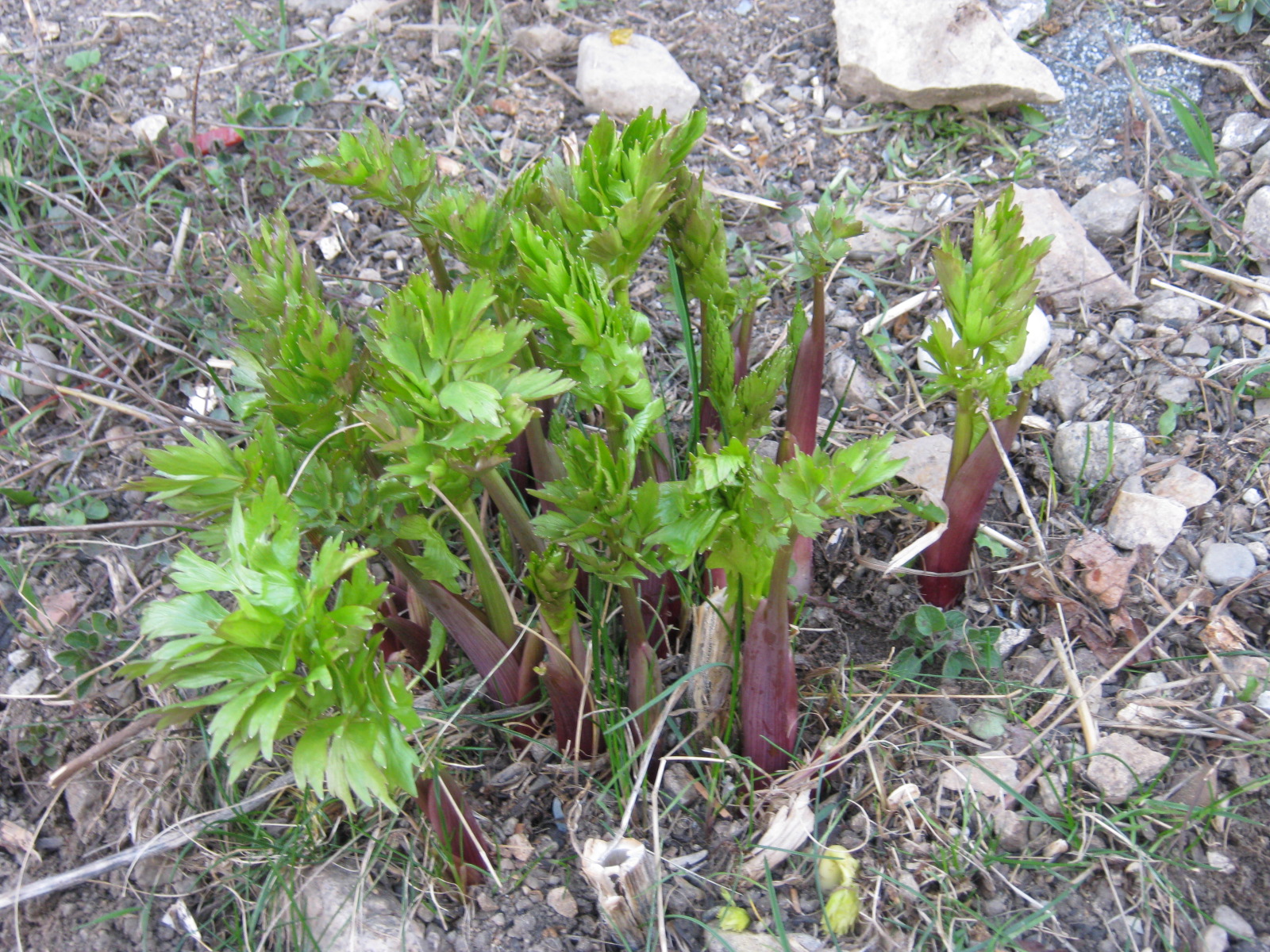
My lovage doing its spring thing

Over here in the New World, church bells are few and far between; I have never lived within the sound of bells here. But I do get to have the flower kind of Easter Bells, and they make me happy.

And on that note, some other things that make me happy are rhubarb, lovage, and chives - the first food crops that start poking their heads out of the ground. I love snow drops and crocuses, because they say that winter is nearly over and spring is here, but it's those green needles of the chive shoots and the red bump of sprouting rhubarb that put the full stop behind that statement. Winter is done. Now when I make soup I don't have to stint on dried lovage any more in order to avoid running out - the new crop is growing, and within a few months that lovage bush is going to be taller than I am and I'll be hacking back the celery-flavoured greenery to keep it from choking out its neighbours in the vegetable bed.

Rhubarb rhubarbing
Oh, and those of you who are still buried under ice and snow, thumb your nose at winter - he's had it. My rhubarb says so.

Life, the Universe, Easter Bells and Things That Make Me Happy. Have a wonderful spring!

24 March 2013

The Mary Ellen Carter

Two days ago we attended the memorial service for our friend, mentor and role model, a truly remarkable man. With just his twelve-string guitar and his voice, he would lead crowds of sixty or more people in singing. He gave the biggest hugs and shoulder squeezes, and had the most penetratingly blue eyes of anyone I've known. His deep love of God and of people made an indelible impression on countless lives.
Three of his four sons, one of them a professional musician, stood at the front of the church, and in his honour they sang this song.
Goodbye, my friend; rest in peace until we meet again.


10 March 2013

Holy Sonnet X


Death, be not proud, though some have called thee
Mighty and dreadful, for thou art not so;
For those, whom thou think'st thou dost overthrow,
Die not, poor Death, nor yet canst thou kill me.
From rest and sleep, which but thy pictures be,
Much pleasure, then from thee much more must flow,
And soonest our best men with thee do go,
Rest of their bones, and soul's delivery.
Thou'rt slave to Fate, chance, kings, and desperate men,
And dost with poison, war, and sickness dwell,
And poppy, or charms can make us sleep as well,
And better than thy stroke;  why swell'st thou then?
One short sleep past, we wake eternally,
And Death shall be no more;  Death, thou shalt die. 


(John Donne)

26 February 2013

Refrigerator Art

Because I didn't post a picture last time, this week you get two. It's Art (note the capital!). Refrigerator Art, to be precise, because that is its locus. No, not its focus - what that is, I leave you to decide for yourself; just the locus - the place where it's at. Or where it was when I created it - Art is transient; it's all been moved around since then. Art is also in the eye of the Beholder. That's called Reader Response Criticism, or something. Probably something.

So here you are: one Poem, entitled "Midsummer Night's Ball":

Midsummer Night's Ball


And then, there's a Sculpture (note capital!). No, not a Sculpture really - an Arrangement? Oh, I know: it's a Visual Poem (note: TWO capitals!). It's entitled - ummm... how about "Untitled"? That means you can pick whatever title suits you. Go for it. (Incidentally, they're little bendable magnetic guys which I picked up at the San Francisco airport, in the SFMOMA gift shop. Aren't they cute?)

Untitled


Life, the Universe, and Refrigerator Art. Magnetising, ain't it.

19 February 2013

Rabbit Trails and Dust Bunnies

Things I learned about today: the meaning of "heuristic"; Burma; Richard Wellesley, 1st Marquess Wellesley (no, not the Duke of Wellington. This guy was his brother.); Singapore; Stamford Raffles; the fact that Queen Victoria at age 44 looked about 60, and that John Brown was a couple of years younger than her; where Jaipur and Udaipur are on a map of India; that Wellington was the Queen's great-great-great-something-uncle; that the Queen Mum grew up in Glamis Castle (you know, as in Macbeth? Thane of Glamis? Except her dad was the real deal, and didn't murder any kings, either.) and that she rejected her husband's marriage proposal twice because she didn't want to be a member of the Royal Family (never mind queen)... oh, and probably a few other things that I'll remember at some opportune moment. And all of that while I was supposed to be reading a chapter in Alastair Pennycook's The Cultural Politics of English as an International Language.

You see, I get off on rabbit trails. Wikipedia is really bad for that. You look up Wellesley because he's mentioned in the book, and it says on the wiki that he was the Queen's great-great-great-etc-grandfather, so you click on the link about the Queen, and then on one about the Queen Mum, and so on and so forth... And then you finally wrench yourself back to the textbook, and read about Malay, and you realize you have no clue what exactly they're talking about, so back to Google you go. Half an hour and several dozen rabbit trails later you emerge, and drag yourself back to your book, only to be confronted with the name Stamford Raffles, as if this was somebody your mother went to Kindergarten with and you'd heard about him all your life. So of course you have to look him up; information is important, isn't it? Lippity-lop down the rabbit trail...

And you know what's at the end of the rabbit trails? Dust bunnies, that's what. You see, the more rabbit trails you follow in the course of your day, the less time you have to get out your trusty ostrich-feather duster, or your not-quite-so-trusty cordless rechargeable dust buster, and go after the fluffy little critters in the corners of you living room and under the couches. So they multiply, growing by leaps and bounds. Which is probably why they're called dust bunnies, those leaps and bounds. Lippity-lop... A house with dust bunnies is a sure sign that its inhabitants are prone to following rabbit trails.

Incidentally, I wonder if Stamford Raffles had anything to do with raffle tickets? Maybe he was the original fundraiser, selling draw tickets for early-nineteenth-century arts and crafts to support his trip to Asia, and that activity was called "raffling" after him. Eh? I'm going to have to look it up.

Life, the Universe, and Rabbit Trails. Beware the dust bunnies at the end of them.