06 August 2013

Summer and Its Downsides

It's summer. High summer, Hochsommer, as we would say in German. That's as opposed to midsummer, which, oddly enough, is the beginning of summer, not the middle of it. Last year this time I went to see the prairies; here's one of the leftover pictures which I never posted last time:
ducks on a slough

And here's some other leftover pictures from last year:
view with grape leaves

That grapevine winding itself over the railing of my deck is rather more prolific (and unfortunately, less healthy) this year, which means I don't get a lot of these kinds of views any more:
boat through railing

But that's okay. I like the grape. And for next year, we can prune it so it fills in the sides of the deck instead of the lake-facing front.

When I started this post, I had actually intended to whine a bit about summer. Being of North-Western European blood, the summer weather in South-Central British Columbia is, usually, too much for me. In Germany, 30ºC is a heat wave; here, it's normal. My system doesn't cope well. And we don't have functional central air conditioning in the house, just a couple of window unit machines. I must say, the one in my bedroom/office has been a life saver - okay, maybe not a life saver, but a sanity saver for sure. I literally start to lose it when it gets hot, go into depression.

Come to think of it, that's what I need to tell you about today: there is such a thing as summer depression. You've heard of SAD, Seasonal Affective Disorder? Well, there's a summer variant. Unlike the winter version, which is brought on by lack of light, the summer one comes from too much heat. And while it's a lot less common than winter SAD, it's just as real, and just as debilitating. The summer one can have symptoms that are a little different, sometimes the opposite of the winter version: summer SAD can lead to sleeping too little, make for agitation, irritability and anxiety, and be more likely to lead to loss of appetite rather than excess appetite. Or so I hear - the latter never seems to be the case for me; in either version, I eat and drink too much - or too much junk, at any rate. I should be so lucky as to lose weight with any of my depressions. Pffft.

Oh, and yes, you can have both varieties of SAD. Case in point: Yours Truly (takes theatrical bow). Too little sun in winter has me dragging my feet, too much in summer does the same. It doesn't matter that I look out on the most gorgeous views you can imagine; when it's really hot, I can't enjoy them. In fact, looking out on my yard and seeing all the scorched grass and dying vegetable beds, with everything either gone to seed or overrun with weeds (which seem to be the only things thriving in this weather), is enough to send me the rest of the way off the cliff. I have to do the hide-my-face thing - "Lalala, I'm not seeing this, I'm just ignoring it all, lalala..." In summer, a nice cool day with rain showers brings me back to life - just like sunshine does in the middle of winter. All of a sudden my energy springs back up; I can do things - cook, clean, do projects, bake something, make something, write, plan, be pleasant...

If you've never experienced how the weather, physical circumstance, can affect a person, you'll have no clue what I'm talking about. No, it's not a matter of self-discipline. No, I cannot just pull myself up by my bootstraps, or sandal straps, as it were. And no, you're not any more virtuous than I am because you don't have these problems. Okay, sorry, that was uncalled for - you probably weren't thinking any such thing. Forgive me. I was projecting my own self-assessment on you. Because, you see, when you (meaning I) get into these moods, you think that it is your fault. That you really should be able to function like you do the rest of the year, like everyone else is. And that if you're not, it must be a sign of moral weakness. Lack of determination. Lack of virtue.

When I sat down to write this today, I hadn't planned to talk about this. I was just going to fire off a light-hearted post on the beauties of summer - yes, I'm fully aware of them, and on a day like today, when the thermometer hasn't cracked the 30º ceiling yet, I can actually enjoy them. But then this topic just pushed itself to the forefront, and demanded to be talked of. So if I've delivered a bit of a downer here, I'm sorry. But if, like me, you're one of those people for whose moods summer can be just as bad as winter, maybe this will help you a bit.

See, when everyone around you is glorying in the gorgeousness of the weather, thriving on the heat, loving the sunshine, and all you want to do is hide in a dark room with an air conditioner, or you long for a good bout of rain (which everyone else thinks is just so awful), or you get up yet another day to see the sun glaring in a cloudless sky and think "Oh no! Not again!" - well, you can start to wonder what's wrong with you. And maybe reading this will give you an inkling that you're not the only one, that it's not your fault.

I've got to add my disclaimer here: I'm no medical expert. Of course not; you already knew that. So don't take my word for any of this. But if you think you might be suffering from Summer SAD, go do your homework. There's studies out there, and books of advice far better and more indepth than what I'm talking about. Google "summer SAD", "atypical depression", or "seasonal depression summer variant". And yes, there's ways of dealing with it. Just like light therapy can help with Winter SAD, "coolth therapy" (I just made up that word) helps with Summer SAD. Yes, those air conditioned rooms, that's what I'm talking about. Swims in cool lakes or pools, or lots of cool showers or baths (like, several a day). A holiday in a cooler place, if you can afford it - probably one of the best places is by the seashore (large bodies of moving water, like the breakers on the ocean shore, create negative ionization in the air, which is good for your mental health. Look it up.). That can all be helpful for getting over the hot times until September rolls around and you can breathe again.

But meanwhile, most importantly, remember that this is real, that it's not your fault, and that you're not alone. So go easy on yourself, be kind to yourself. And get a really cold drink, a good book, and a hammock, and take a few hours off. There's a good reason afternoon siestas are a national institution in hot countries.
Like that. Johnny's got the right idea - there's nobody who can take a siesta like a cat.

Life, the Universe, and Summer. Despite its downsides, I still can love it.

02 August 2013

Bloggiversary

It was our third bloggiversary yesterday, Steve's and mine. Meaning we've been blogging for three years now. So in honour of the occasion, here is Steve sitting on a wood stack on the campsite where we were last weekend. I didn't share my scrambled eggs with him, though - he's picky about them, and I hate people being picky about food. Even if they're furry bears.
Apart from that, I really have nothing much to say today. So this was Life, the Universe, and a Bloggiversary. Happy August from me and Steve!

31 July 2013

How to Barbecue a Pot

I've been barbecuing a pot. No, not pot - we're not talking about marijuana shishkabobs - but a pot. A cast iron casserole, to be precise.

I found it at the second-hand store when I was on a quest for a pot to use for camping. Brilliant, I thinks - cast iron can go right into the campfire, that's perfect! So I grabbed it, paid my $12.99 (that's a decent deal for a cast iron pot, even an unprepossessing no-name one like this - it's not a Lodge, let alone Griswold, but it's cast iron), and triumphantly bore it home. But when I took a closer look at the thing, it turned out to have been previously owned by someone of the never-wash-cast-iron-it'll-ruin-it persuasion, which, of course, ruined it. It had a layer of black crud all around the inside of the pot and the lid, some of it almost 2mm thick. Not pretty. I think anything cooked in that pot would have had a nice seasoning of black flaky who-knows-what mixed in.

For starters, I tried soaking it in water, which, needless to say, didn't do much at all. Oh yes, some of the crud flaked off, exposing bare iron underneath, which promptly started rusting. (That's exactly what would have happened if I had cooked, say, chili in it. Yummy.) So now I had a crud-covered pot with rust spots interspersed with the black bumpy layer of baked-on whatever-it-was.

Discouraged yet? Well, I wasn't. You see, long before I bought that pot, I had read up on this stuff online. Cast iron is almost indestructible. You know your cast iron pot is ruined when - well, maybe when it's got a hole in it. The kind you can see daylight through, when the pot literally falls apart. Otherwise, you can fix it. So that's what I proceeded to do, according to the instructions on the websites I found.

The first step was oven cleaner. Yes, the really harsh, stinky, spray-on kind, that makes you cough and gag while using it. Yuck. I took the pot and a big garbage bag, sat the pot inside the bag, put everything together into a cardboard box, took it out into the driveway, suited myself up in long pants, long-sleeved shirt and rubber gloves (I just about had a heat stroke), and sprayed down the whole pot and lid, inside and out, with the oven cleaner [cough, hack]. Then I closed the bag, shut the lid on the box, and put it up high out of reach of the cats. The point of the bagging is to keep the oven cleaner from evaporating, so it can work longer (the point of the closed box is cat protection).

I left the whole thing sitting for about 18 hours. Longer would have been better, but I'm impatient, so I suited up in my chemical hazard gear again and brought the whole box in to the kitchen sink. When I took the pot out of the bag, a lot of the buildup had turned from hard, crusty crud into black, goopy crud that just washed right off the pot. Now, it would have been better to have given it another coat of oven cleaner and put it back in the bag for another day to dissolve the remaining crud, but, well, did I mention I'm impatient? So I tackled the rest of it with elbow grease and a stainless steel scrubby pad. I got pretty much all of it off by the sweat of my brow. (Literally, I had sweat pouring down my face. Long-sleeved sweaters aren't the most congenial items of clothing for the kind of weather we had yesterday).

So now I had a crud-free pot, stripped down to the bare grey iron, which immediately developed a coating of rust all over it. I knew that would happen - no big deal. Those websites about how to recondition cast iron have various suggestions for what to do about the rust, but I found just giving it a good wash in very hot water and then drying it right away took most of it off.

And then came the barbecuing part. Well, first the oil. You'll find various suggestions for which fats are most suitable for seasoning cast iron (lard is the most traditional choice), but I followed the advice of Sheryl Canter on this website, who recommends using unrefined flaxseed oil for the purpose. As an occasional oil painter, her reasoning makes heaps of sense to me - flaxseed or linseed oil is a drying oil, which actually means not "drying" as in "water evaporation", but solidifying by polymerisation. Linseed-oil-based paintings have a very hard surface, once they're fully cured. See, that's also the nonsense behind the "don't wash cast iron with soap" idea: cast iron seasoning is oil, goes the reasoning, and soap dissolves oil, so ergo, no soap on cast iron. But by the time the oil is bonded with carbon onto the iron, it's not ordinary oil any longer that can just be washed off with soap - just like you can clean an oil painting with soapy water without doing any damage to it, or scrub your kitchen walls, which might be painted with oil-based paints, as much as you like. To be fair, the idea of "no soap on cast iron" probably originated in the days when soap was homemade and possibly had a surfeit of lye in it (if the soap recipe or procedure wasn't quite right - but that's another blog post), and lye, as the oven cleaner process shows, does strip cast iron down to its bare metal.

So I rubbed the clean, very slightly rusty pot all over with linseed oil. And then I rubbed most of it off again. You want a thin layer - many thin layers, not one thick one. (Once again, look to oil painting - the thick blobs take forever to cure and always stay blobby, which is one of the advantages of oils to painting, but not to cast-iron-curing.) And THEN (yes, I did eventually come to that) I stuck it on the barbecue. Upside down, the lid leaning up against it. And lit the BBQ, let it get to about 500ºF (260ºC) and let the pot cook for an hour.


It would, of course, be possible to do this in the kitchen oven. But for one, it was a hot day, and the last thing I needed was for my kitchen to get any hotter (30ºC is more than enough, thank you). But more importantly, the point of seasoning cast iron is that you need to get past the smoke point of the oil; in a sense, you're burning the oil onto the iron. So by its very definition, this process generates smoke. In fact, between the burger drippings burning off the barbecue, and the oil from the pot, it generated enough smoke coming in through the windows to set off my smoke alarm inside the house. (I closed the windows after that.)

Then I turned the barbecue off, let the pot cool a bit, gave it another layer of oil, and repeated the process (there was far less smoke by then, without the burger drippings). Ideally, the pot should have about six coats, but, well, I did mention I'm impatient, didn't I? So it's just got two coats so far. I might give it a few more later. But even as is, it's got a beautiful, even black sheen, just like any pre-seasoned cast iron pot you get from the store. It's a thing of beauty and a joy forever. Well, for a while, anyway, until I cook enough tomato-sauce based dishes in it to strip the seasoning again. Rubbing a thin layer of oil back onto the pot after cleaning it helps with that.

So there you have it. Life, the Universe, and a Barbecued Cast Iron Pot. I'm quite proud of it.


24 July 2013

How to Write a Term Paper

Steve demonstrating the state of one's mind during Term Paper Writing
1.) Pick a topic. Find something you're interested enough in that you won't end up hating it after having completely immersed yourself in it for weeks on end.
2.) Vaguely think about it off and on while you do the other assignments for your course, hang around on Facebook, and read murder mysteries in your off time.
3.) Hit the library. No, wait - first hit the library's website, and surf around, following improbable rabbit trails through the jungle of Library of Congress Subject Headings.
4.) Repeat step 3.) on Google. It's amazing the stuff you can find - say you're researching Austen film adaptations, you might find out that Jennifer Ehle played some other costume drama with Jeremy Northam, and that she looked a whole lot better with her hair natural, rather than that dorky wig they put on her for the 1995 P&P. This step can occupy you for a long, long time.
5.) Go to the library and pick up the two dozen books you ordered in on your topic. Stack them around your computer.
6.) Panic.
7.) Send an email to your prof, whining about not getting ahead. Try to change your topic a time or two.
8.) Procrastinate.
9.) Panic.
10.) Get several pads of sticky notes, the real skinny strips, preferably fluorescent-coloured. You need them to mark sections you're going to quote in the books. Don't even THINK about actually highlighting library books, or even just underlining stuff and making notes in pencil. You will be smote by the library gods. (I'm sure there are some. Some Greek gods of libraries? And they're very smiting, believe me. Especially after having had their powers enhanced by my righteous indignation at all those scribbles and markings in the margins. Grrrrrr...)
11.) Repeat step 4.)
12.) Go on the library website, pull up the databases the library subscribes to, and repeat step 3.) Save about three dozen references in a special folder. The next day, go back and open every single one of those .pdf files which will all have titles like 678459q84.pdf, and rename them so you can actually recognize them when they're closed. Go back into the databases, repeat your search, then actually save the references to the files you've found. Export them to RefWorks.
13.) Panic.
14.) Eat copious quantities of snacks.
15.) Start reading. Or at least, open those .pdf files, and skim over the contents. Highlight interesting sentences, even if you have no clue what the author said on the page before or after the quote. (Yes, you may highlight. The library gods do not care about alterations of electronic files.)
16.) Crack open the covers of those library books, and follow the general principle of step 15.), replacing "highlight" with "sticky-note". You may write on the sticky note, if you manage to not draw outside the line and accidentally write on the page of the book. If you do the latter, you will be smote.
17.) Procrastinate.
18.) Panic.
19.) Feel put upon.
20.) Pace.
21.) Open several text files in your favourite writing program, such as Scrivener. One will be your main text body. Another will be random notes. Scribble down everything and anything that came into your head when you were doing all that pacing, procrastinating and panicking (see, they have a purpose!). Copy and paste quotes you want to use from the .pdf's; swear at the fact that Adobe Reader won't let you copy something you've highlighted. Go back and pull a clean .pdf off the net, so you can copy and paste from it. Manually copy quotes from the hardcopy books. Throw all those citations randomly into your notes file.
22.) Sleep and eat. Don't panic too much at this point, it interferes with sleeping and eating.
23.) Whine at your family and friends about the stress levels you're under. Tell them what you're writing about (it helps. See "pacing, procrastinating and panicking"). Stop telling them when their eyes glaze over.
23.) Open your notes file. Sort your ideas into a semblance of sense. Cut and paste the quotations, and stick them in the right categories.
24.) Panic.
25.) Open your text body file in one window, your notes file in another. Take a deep breath. Start typing.
26.) Keep telling yourself "Just write, just write, just write - you can edit it later - just write... yes, this sounds awful... just write..."
27.) Make sure to frequently hit "save".
28.) Repeats steps 22.), 23.), 24.) - 27.) as often as needed.
29.) Include in-text citations as  you write, or leave them to the end, as you choose.
30.) Read over what you've done. Fix the really glaring nonsense (if the wording makes you gag, chances are your prof won't like it either).
31.) Boot up RefWorks, pick the four references you actually used of the three dozen you saved, and build your Works Cited list. Manually enter the reference information for the hardcopy books.
32.) Copy and paste it to your text file.
33.) Pick a snappy title for your piece.
34.) Export everything to the file that will be your final paper file.
35.) Spellcheck and format your paper. Swear at the word processing software which does weird things with margins and fonts, and insists on spellchecking in US English instead of British or Canadian. No, I do NOT want to change "colour" to "color"!
36.) Hit save.
37.) Have a glass of wine or two to celebrate. Go sleep.
38.) Open the file, read it over. Shake your head at all the mistakes you've missed. Fix them. Make sure all your citation information is correct and shipshape.
39.) Save everything to a few other files, just to make sure you don't lose it. Give the files an academic-sounding name. (No, "Bob" won't do.)
40.) Read the paper over again, just to be sure.
41.) Address an email to your prof; attach the file. Quadruple-check that you've actually attached the file and aren't sending him a blank mail. Hover your mouse pointer over the "send" button. Take a deep breath, then another for good measure. Panic mildly. Click "send".
42.) Abandon yourself to The Euphoria of Completion.

There you have it - Forty-Two Steps to Writing a Term Paper. Well, they work for me, anyway. You're welcome.

16 July 2013

Book Fixes

I pulled out my copy of The Lion, the Witch and the Wardrobe, for my next course. Well, one of my copies. This particular one is part of a boxed set that my man gave me many years ago, I think it might have been for our first Christmas after we were married. And then, also many years ago (but not quite as many), one of the kids was practising her scissors skills on the cover. (In her defense it must be said she was quite small. And she never did it again, at least not on book covers - the cat's fur and her own bangs were a different matter. I'm not sure which came first, the hair cut or the book trimming. But in either case, even though I don't remember my reaction exactly, I'm sure it was sufficient to put a healthy respect for the sanctity of the printed page into her. It doesn't seem to have scarred her for life, fortunately.)

So, anyway, this poor book has lived with half a jagged-edged cover for the last however-many years (title: The The Witch A The Wardrob). I even bought another boxed set of the Narnia novels from Scholastic to replace this one, but I could never really warm to that version with its movie-tie-in covers. It seems cheap, somehow. Well, it was cheap - it's Scholastic, after all (I love Scholastic; but quality of physical properties of books is not one of their strong points).

So I pulled out this book from between The Magician's Nephew and Prince Caspian to do preliminary work for my course. It really was pathetic, that half cover. Fortunately, the actual text escaped the ravages of toddler scissors unscathed; only the front matter got hit. The copyright page looks pretty sad, and there's a couple of snips on the edge of the page which has Lewis' dedication letter to his goddaughter Lucy on it, but from the table of contents onwards the paper is intact. But it really didn't feel nice, handling that jagged-edged cover. So I thinks to myself: why not fix this? Can't make it worse, can I?

Now, I love books. Not just reading them, but handling them. I could probably be quite content in a job in the library's processing department, where they stick the Dewey Decimal stickers on the spine and put nice clear covers around the books to keep them looking pristine. Perhaps in another life I was a bookbinder? Anyway, fixing a poor, mutilated book is something that's quite a pleasing endeavor.

I started with a piece of plain white card stock, trimmed it to size, then glue-sticked it to the inside of the cover. So now instead of a half cover with a jagged edge I had a half-coloured cover with a jagged-edged section of white staring at me. Much better on the tactile end, but still not so glorious visually. Along comes the offspring (she of the scissors skills) and says "You should find that cover online, print it out and glue it on!" Brilliant, eh? And that's just what I did - well, the finding and glueing; she actually did the printing (it had to be sized just right to fit, and she's good with stuff like that; besides, she sits next to the printer. And she's just one of those obliging kinds of people).

So now I've got a nice, complete image on the cover of The LION, The Witch AND The WardrobE again. It's a little paler on one side, and the fit isn't 100% exact (due to the cropping of the online image). But that's just one of those pleasing signs of age, sort of like the wrinkles at the corners of my eyes (Velveteen Rabbit, with the plush loved off, that sort of thing). Just a sign that this book has been well-used (not just ill-used). I'm happy.

Life, the Universe, and the Fixing of Books. Now I can have my book fixes again.

10 July 2013

Stacks of Austen and Some Jam

I went to the university library yesterday because I had some holds in. Even though I'm taking my degree through a distance ed university, I get to use the library of the local uni. That deal is called COPPUL, the Consortium Of Pacific and Prairie Libraries; they have an agreement to let each others' students use their libraries. So I get to take out whatever I want - and boy, do I ever!

I've always said that the library is the one place you can impulse-shop with impunity. Whatever catches your eye and strikes your fancy, grab it and take it home. The worst thing that could happen is that you forget to renew it and get hit with overdue fines, or perhaps that you spill your tea over the book and have to pay for it. But in the latter case, you usually get to keep the book, so if you liked it enough to take home, you might not mind owning a copy, albeit a somewhat tea-stained one.

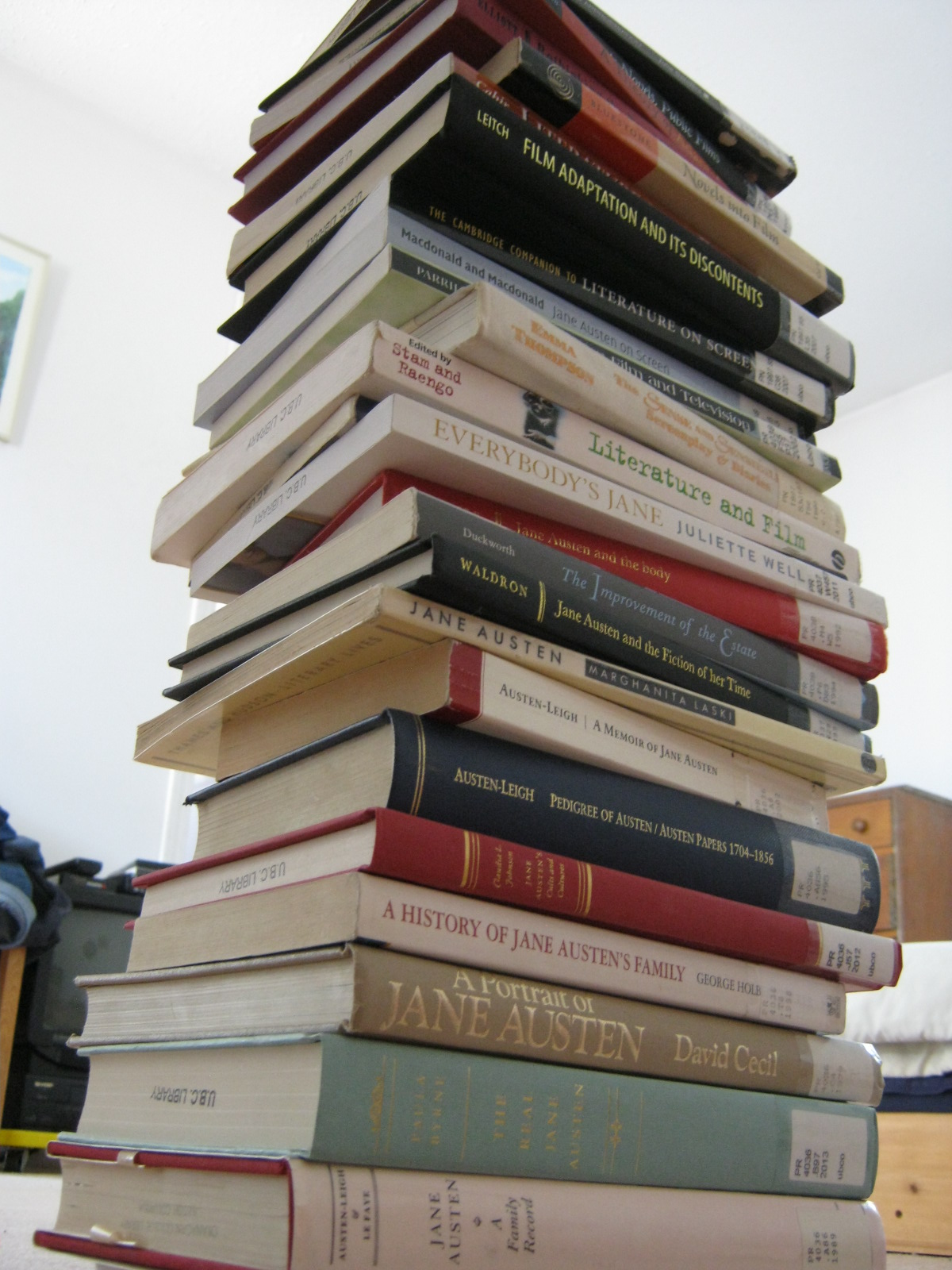
So I had five holds in yesterday - and I walked out of that library with twenty-seven books altogether. Ahem. Well, they made me take them out! C'mon, wouldn't you grab a copy of Jane Austen's letters, or James Edward Austen-Leigh's memoir of his aunt Jane, or Jane Austen on Screen (with a lovely picture on the cover of Kate Winslet smiling winsomely at Allan Rickman)? You wouldn't? How strange. Well, I did.

The thing is that there's a real head rush about browsing the stacks in the library, something that only real bookworms understand. Collecting books with shameless abandon, and only stopping because you can't carry any more - I haven't done that in quite a long time. In fact, it was having a job at the library that made me stop doing that. When you work in the place, you don't browse the stacks any more. You take out what comes across the desk, and what you've ordered in because you found it in the catalogue. And then when I quit my library job, I never did go back to browsing, at least not in the public library. But now I'm doing it in the uni library, and it's lovely.

So am I actually going to read all twenty-seven of those books I took out? Nope, not on your life. I will flip through them, and pick out the bits that interest me and are useful for my paper. But there are some that'll be keepers. My favourite of this lot is The Sense and Sensibility Screenplay and Diaries by Emma Thompson; I already have a copy on order through ABE books. I've always liked Emma Thompson, ever since I first saw her in that movie (she plays Elinor, as well as having written the screenplay), but reading her diaries of the filming, oh my. She's utterly hilarious. And after reading that, I'll be watching the movie with rather different eyes. For example, when she gets up from Marianne's bedside after her night's vigil and rubs her   stiff neck - that's for real. She really did have a sore neck that day, and put it to good use in her acting.

In other news, we got four pounds of raspberries off our bushes in the garden yesterday, which made me quite happy. I only planted those vines two years ago; they were hand-me-downs from when my sister-in-law was pulling out her raspberries. So this morning I made jam, eight jars worth of lovely ruby sweetness. And being afflicted these days with early-waking insomnia, I was up in time to get it done by 9:00 - that's a record, for me.

Life, the Universe, Browsing the Stacks and Raspberry Jam. The small pleasures of life.

02 July 2013

Jane Austenite

summer balcony view
"I am a Jane Austenite, and therefore slightly imbecile about Jane Austen. My fatuous expression and airs of personal immunity - how ill they set on the face, say, of a Stevensonian! But Jane Austen is so different. She is my favorite author! I read and reread, the mouth open and the mind closed. Shut up in measureless content, I greet her by the name of most kind hostess, while criticism slumbers."

That's E. M. Forster said that, not me (see citation below). I feel vindicated. Because he's a famous writer, so he ought to know. Nowadays, we mostly call ourselves Janeites, not Jane Austenites so much, although I believe Forster's the one who invented the term, back when he wrote this in 1936. [Addendum: no, he wasn't. Wikipedia says that the term "Janeite" was coined by George Saintsbury in 1894, and that Kipling wrote a short story called "The Janeites" about a group of WWI soldiers who're fans. Might have to track that one down, sounds intriguing.]

I've thoroughly enjoyed rereading the novels for my course, although it's taken me about four times longer than I had bargained for. Partially that's due to the fact that as soon as I have to do something for school, it becomes work, and therefore something to be avoided; that cuts down on processing speed considerably. And the other part was that really reading, carefully, every word, plus the forewords and afterwords and bonus materials, just takes longer than skipping through to get to your favourite bits (even if you read those three times over because you like them so much). But I'm done the reading, so now I can go into the writing.

On another note, the weather gods suddenly decided to crank up the thermostat, just in time for the beginning of the summer holidays. Today we're supposed to get to 34°C; this morning at 8:00, it was already 32°C in my east-facing kitchen, what with the sun burning through the window and patio doors. Thank God for the new window unit air conditioner in my bedroom/study; my papers would be doomed without it.

Life, the Universe, and Imbecile Jane Austenites. Keep cool!

(Forster, E. M. "Jane Austen: the Six Novels". A Truth Universally Acknowledged: 33 Great Writers on Why We Read Jane Austen. New York: Random House, 2009. 22-25.)